

How does ADCETRIS work?
The science of ADCETRIS treatment
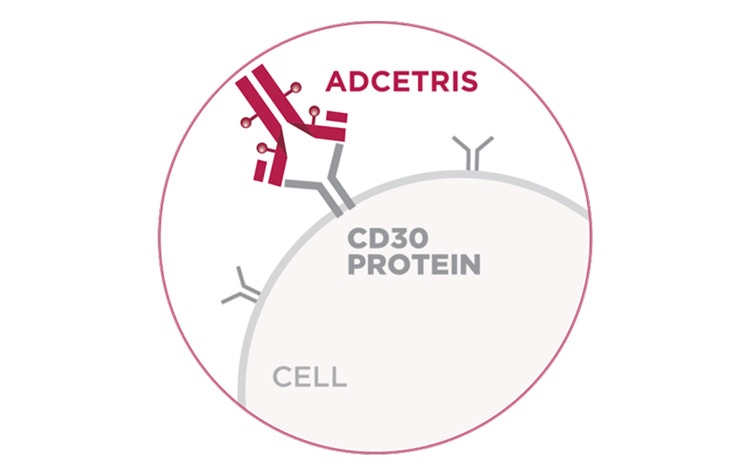
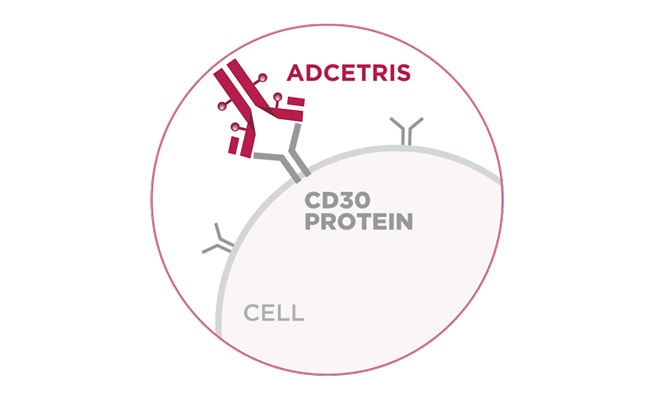
Step 1
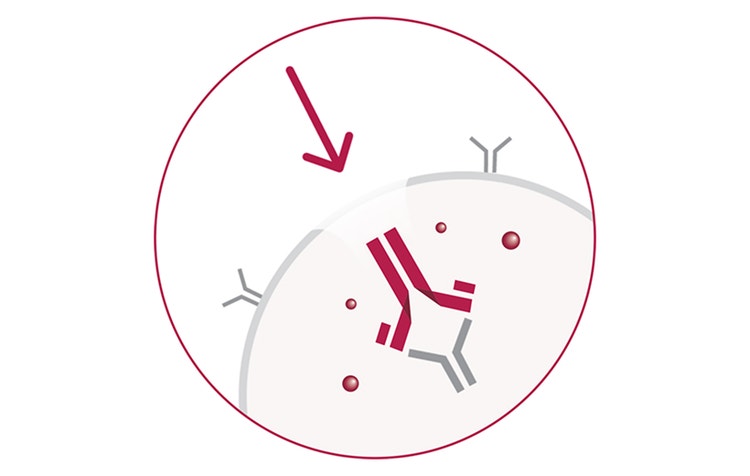
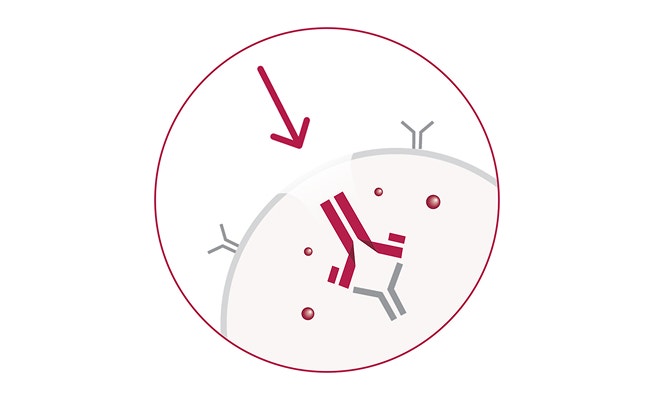
Step 2
Step 3
Could a targeted approach with ADCETRIS be right for you?

Video Transcript
ADCETRIS is not like traditional chemotherapy. It is made up of three parts: an antibody that is synthetically engineered. Normally, antibodies are proteins made by the body's immune system. In ADCETRIS, the antibody targets CD30, a protein that can be found on B and T cells, but can also be found in higher than normal amounts on cancer cells such as lymphoma cells.
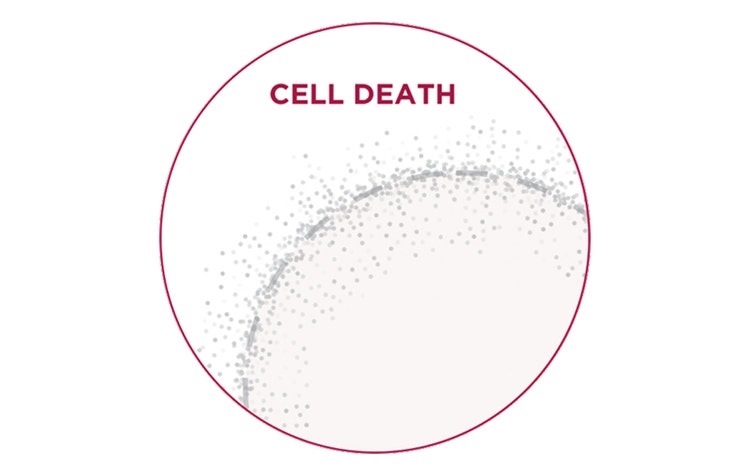
The second part of ADCETRIS is a drug that is designed to cause cell death. The third and final part is a linker that attaches the drug to the antibody, then releases the drug inside the cell. ADCETRIS works in three particular steps. First, ADCETRIS targets cells that have the CD30 protein on their surface. Next, once attached, ADCETRIS is brought into the cell and released. In the third step, the drug then stops the cell from being able to grow and divide, causing the cell to die.
It's important to note that CD30 is a protein found on certain lymphoma cells and not commonly found on healthy cells.
Still, even though ADCETRIS is a CD30-directed therapy, it may still harm normal cells and cause side effects.
Important Safety Information and Use(s)
What is ADCETRIS?
ADCETRIS is a prescription medicine directed against the CD30 protein. It is used to treat:
- Adults with previously untreated stage 3 or 4 classical Hodgkin lymphoma (cHL), in combination with chemotherapy (Adriamycin, vinblastine, and dacarbazine)
- Children 2 years of age and older with previously untreated high-risk classical Hodgkin lymphoma (cHL) in combination with chemotherapy (doxorubicin, vincristine, etoposide, prednisone, and cyclophosphamide)
- Adults with classical Hodgkin lymphoma (cHL) at high risk of coming back or becoming worse after a stem cell transplant (auto-HSCT)
- Adults with classical Hodgkin lymphoma (cHL) after a stem cell transplant fails or after at least two chemotherapy treatments fail and stem cell transplant is not an option
- Adults with previously untreated systemic anaplastic large cell lymphoma (sALCL) or other CD30-expressing peripheral T-cell lymphomas (PTCLs), including angioimmunoblastic T-cell lymphoma and peripheral T-cell lymphomas not otherwise specified, in combination with chemotherapy (cyclophosphamide, doxorubicin, and prednisone)
- Adults with systemic anaplastic large cell lymphoma (sALCL) after at least 1 combination chemotherapy treatment fails
- Adults with primary cutaneous anaplastic large cell lymphoma (pcALCL) or CD30-expressing mycosis fungoides (MF) after systemic therapy (drugs that spread throughout the body)
- Adults with relapsed or refractory large B-cell lymphoma (LBCL) including diffuse large B-cell lymphoma (DLBCL) not otherwise specified (NOS), DLBCL arising from indolent lymphoma, or high-grade B-cell lymphoma (HGBL), after two or more lines of systemic therapy who are not eligible for stem cell transplant or chimeric antigen receptor (CAR) T-cell therapy, in combination with lenalidomide and a rituximab product
Important Safety Information
What is the most important serious safety information I should know about ADCETRIS?
- Progressive Multifocal Leukoencephalopathy (PML): Patients treated with ADCETRIS can have a rare, serious brain infection, called PML that can lead to death. Tell your doctor immediately if you have mood or behavior changes, confusion, problems in thinking or loss of memory, changes in vision, speech or walking, or decreased strength or weakness on one side of the body. PML may also be caused by prior treatments or diseases that weakened your immune system.
- Do not take ADCETRIS if you are receiving bleomycin due to pulmonary toxicity (serious lung problems).
What are the other possible serious side effects of ADCETRIS?
- Nerve damage (peripheral neuropathy). Tell your doctor if you have any numbness or tingling in your hands or feet or any muscle weakness.
- Allergic and infusion reactions. Infusion related reactions and severe life-threatening forms of an allergic reaction (anaphylaxis), have occurred with ADCETRIS. Tell your doctor if you experience symptoms of fever, chills, rash, or breathing problems within 24 hours of infusion. If you have a reaction, you may be given medicines before your ADCETRIS treatment.
- Blood problems. Serious cases, including death, of fever with a low number of white blood cells (neutropenia) or weakened immune system have occurred with ADCETRIS. Serious cases of a low number of white blood cells, a low number of platelets, or a low number of red blood cells can occur. Tell your doctor if you have a fever of 100.5°F or higher, pain when you urinate, chills, or cough.
Your doctor will do blood tests to check your blood cell levels during ADCETRIS treatment. Your doctor may give you a medicine called granulocyte colony stimulating factor (G-CSF).
- Serious Infections: Serious infections and infections caused by bacteria, viruses or fungi, including deaths, have occurred with ADCETRIS. Symptoms include fever, chills, and flu-like symptoms.
- Tumor lysis syndrome is caused by the fast breakdown of cancer cells. Your doctor may do blood tests to check you for TLS and will monitor you for symptoms.
- Patients with severe kidney disease or moderate or severe liver disease may have more serious side effects and deaths than patients without kidney or liver problems. Patients with severe kidney disease or moderate or severe liver disease should not use ADCETRIS.
- Liver problems. Serious liver problems, including death, have occurred with ADCETRIS. Tell your doctor if you feel tired, have a loss of appetite, right upper stomach pain, dark urine, or yellow skin and eyes (jaundice).
- Lung problems. Serious lung problems, including death, have been reported with ADCETRIS. Tell your doctor If you have a new cough, a cough that gets worse or shortness of breath.
- Serious skin problems called Stevens-Johnson syndrome and toxic epidermal necrolysis, including death, have been reported. Tell your doctor if you have skin rash, hives, sores in your mouth, or blistering or peeling skin.
- Gastrointestinal (GI) problems. Serious cases, including death, related to the pancreas, stomach, intestine, and colon have been reported. If you have lymphoma that involves your stomach or intestine, you could have a higher risk of GI problems. Tell your doctor if you have severe stomach pain, chills, fever, nausea, vomiting, or diarrhea.
- High blood sugar. Serious cases of hyperglycemia, including death, have been reported. Your doctor will test your blood during ADCETRIS treatment. Tell your doctor if you need to urinate more often than usual, are very thirsty, have blurry vision or are confused.
- Pregnancy: ADCETRIS can harm an unborn baby. Tell your doctor if you are or plan to become pregnant.
The most common side effects (≥20%) in adult patients who received ADCETRIS are:
- nerve damage (peripheral neuropathy)
- nausea
- feeling tired
- muscle pain
- constipation
- diarrhea
- vomiting
- fever
- upper airway infection (nose, sinuses or throat)
- soreness, swelling or sores in the mouth and/or digestive tract
- upper stomach pain
- rash
The most common laboratory abnormalities (≥20%) in adult patients who received ADCETRIS are:
- a decrease in white blood cells
- an increase in creatinine
- a decrease in hemoglobin
- an increase in blood sugars
- an increase in alanine aminotransferase (ALT)
- an increase of aspartate aminotransferase (AST)
The most common severe side effects (≥5%) in pediatric patients who received ADCETRIS are:
- a low number with white blood cells
- a low number of red blood cells
- a low number of platelets
- fever with a low number of white blood cells
- sores or swelling in the mouth
- infection
These are not all the possible side effects of ADCETRIS. Tell your doctor about any side effect that bothers you or does not go away. If you have certain side effects, your doctor may lower your dose, delay, or stop your ADCETRIS treatment.
What should I tell my doctor before I start treatment with ADCETRIS?
- All your medical conditions, including if you have kidney, liver, or lung problems, an infection, or diabetes.
- If you are pregnant or plan to become pregnant. ADCETRIS may harm your unborn baby.
- Females who are able to become pregnant: Your doctor should give you a pregnancy test before starting ADCETRIS treatment. You should use effective birth control during ADCETRIS treatment and for 2 months after your last dose of ADCETRIS. Tell your doctor right away if you become pregnant or think you are pregnant during ADCETRIS treatment.
- Men with female partners who can get pregnant should use effective birth control during ADCETRIS treatment and for 4 months after the last dose.
- If you are breastfeeding or plan to breastfeed. Do not breastfeed during ADCETRIS treatment.
- All the medicines you take, including prescription and over-the-counter medicines, vitamins, and herbal supplements. ADCETRIS and certain other medicines can affect each other.
Patients should always ask their healthcare providers for medical advice about adverse events.
You are encouraged to report adverse events related to Pfizer products by calling 1-800-438-1985 (U.S. only). If you prefer, you may contact the U.S. Food and Drug Administration (FDA) directly. Visit www.fda.gov/MedWatch or call 1-800-FDA-1088.
Please see Important Facts about ADCETRIS, including BOXED WARNING on ADCETRIS.com.
Please see full Prescribing Information, including BOXED WARNING, for ADCETRIS on ADCETRIS.com.